China Top 10 Modern Log Cabin Manufacturers?
China’s modern cabin industry is moving beyond rustic holiday homes. It now combines engineered timber, factory precision, energy efficiency, and export-ready design. This shift deserves careful evaluation.
The United Nations Environment Programme’s 2023 Global Status Report states that buildings and construction consume about 34% of global energy and produce approximately 37% of energy and process-related emissions. That pressure encourages manufacturers to improve insulation, material efficiency, and construction speed. The International Energy Agency also identifies building efficiency as essential for reducing future energy demand. These findings give practical context to the Modern Log Cabin market.
This guide examines ten Chinese manufacturers through measurable criteria. The review considers timber sourcing, structural engineering, moisture protection, thermal performance, factory quality control, certifications, customization, and after-sales support. Product photographs can look convincing. They are not enough.
A reliable supplier should provide clear wall assemblies, wood species, treatment records, test documentation, and installation guidance. FSC or PEFC-related sourcing evidence may also support responsible procurement, although certification coverage can differ by product line. Buyers should verify every claim independently.
China’s manufacturing advantages include scalable production, CNC processing, prefabricated components, and competitive export logistics. However, low pricing may hide transport complexity, local-code adjustments, or unclear warranty responsibilities. That is where this review remains cautious. A ranking cannot represent every capable workshop, and supplier information can change quickly.
The selected companies are presented as practical candidates, not unquestionable winners. Their suitability depends on climate, site access, budget, building regulations, and intended use. Small details matter, such as roof overhangs, sealed window joints, and the treatment of exposed end grain.
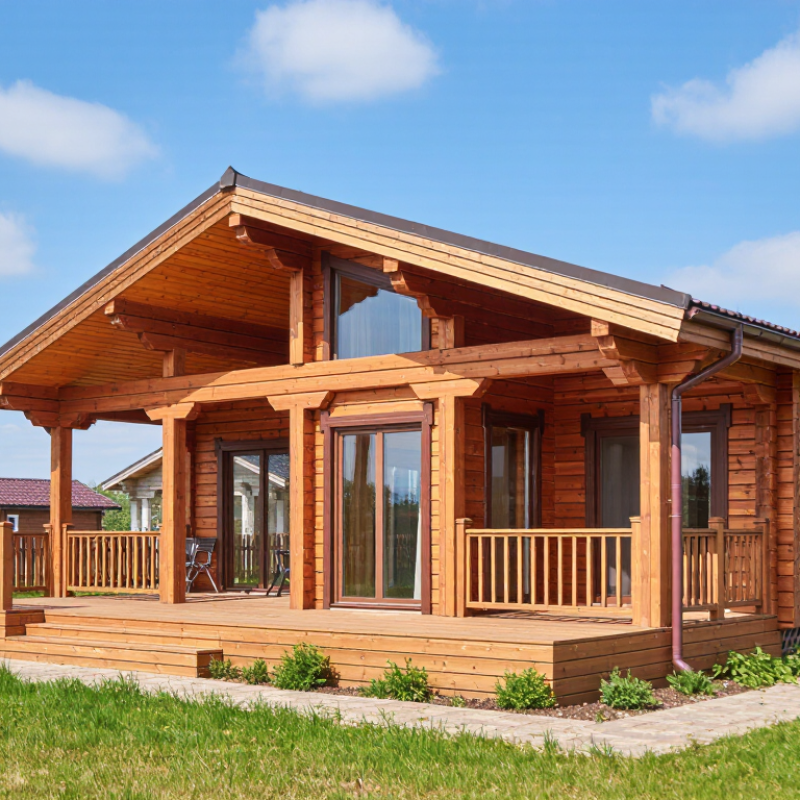
Modern Log Cabins in China: Materials, R-Values, and GB Standards
China Top 10 Modern Log Cabin Manufacturers?
Modern log cabins in China increasingly combine natural timber with high-performance insulation systems. The material choice matters more than appearance. Kiln-dried softwood can reduce shrinkage, while laminated timber offers improved dimensional stability. Exterior cladding, breathable membranes, and mineral wool often strengthen the wall assembly. Preservative treatment must match local humidity, insects, and foundation conditions.
R-values describe resistance to heat flow, but they should not be judged from log thickness alone. A solid 180-millimeter wall may perform differently from an insulated timber frame. Gaps between logs, corner joints, windows, and roof connections can create thermal bridges. Chinese projects should also review U-values, which are commonly used in energy calculations. A higher R-value generally indicates better insulation. Still, test data and installation quality can change actual results.
GB compliance requires more than a material certificate. Designers commonly review relevant editions of GB 50005 for timber structures and GB/T 50361 for wood construction requirements. Regional energy-efficiency rules, fire provisions, moisture control, and structural safety also need checking. Site-specific documentation is essential. In practice, some cabin drawings appear complete but miss drainage details or ventilation paths. That is a weakness worth correcting before construction. Local engineers should verify loads, seismic conditions, snow exposure, and foundation connections.
Modern Log Cabins in China: Indicative R-Values by Wall Material
Indicative thermal resistance of a 140 mm uniform material layer. R-values are calculated as thickness divided by thermal conductivity: R = d/λ. Actual cabin performance depends on moisture, thermal bridges, joints, insulation continuity, windows, and the complete wall assembly.
Values shown: softwood log, wood-fiber insulation, mineral wool, and EPS insulation. The chart is for material comparison only and does not represent a universal Chinese code limit. Project compliance should be checked against the applicable climate zone and the current requirements of GB 55015-2021, together with relevant fire-safety and wood-structure provisions such as GB 50016 and GB/T 51350.
How the Top 10 Manufacturers Are Ranked by Capacity, Quality, and Export Data
China Top 10 Modern Log Cabin Manufacturers
A credible ranking needs more than factory photographs. I would score capacity at 40%, quality at 35%, and export performance at 25%.
Capacity should use audited annual output, production lines, kiln capacity, and delivery records. Public claims can mislead. Some factories report maximum capacity, not actual production.
For quality, assess timber moisture, structural testing, coating durability, and documented inspection procedures. The ISO Survey 2022 shows ISO 9001 remains widely used worldwide, but certification alone cannot prove superior cabins.
Material traceability matters more. FAO’s Global Forest Resources Assessment 2020 records China’s forest area at roughly 220 million hectares, yet available timber is not automatically construction-grade.
Export data should come from China Customs and UN Comtrade, especially HS 9406 records for prefabricated buildings. Compare three-year export value, shipment frequency, destination diversity, and rejection rates. A single strong year is not enough.
Tips:
Ask for audited capacity, recent shipment evidence, moisture-test reports, and factory inspection videos. Check whether the quoted output reflects finished cabins or unfinished panels. This distinction is easy to miss.
The ranking remains imperfect because customs codes include several building types, not only log cabins. That limitation should be stated clearly.
Top 10 Chinese Manufacturers: Design Systems, Production Scale, and Certifications
China Top 10 Modern Log Cabin Manufacturers?
A credible top-ten review should examine systems, not showroom photos. Grand View Research reported strong growth in the global prefabricated buildings market through 2030. This demand rewards manufacturers with repeatable designs, accurate cutting, and shorter assembly times. Leading Chinese factories often use CNC timber processing, insulated wall panels, and digital production records. A typical workshop may label every beam before loading. That small detail reduces site confusion.
Production scale still requires evidence. Ask for monthly output, kiln-drying capacity, moisture targets, and export packaging procedures. The ISO Survey 2023 places China among the largest holders of ISO 9001 certificates worldwide. However, certification alone does not prove cabin quality. Buyers should verify certificate scope, audit dates, and whether the factory actually builds timber structures. Relevant documentation may include FSC chain-of-custody records, CE declarations for applicable products, and local structural test reports. Requirements vary by destination.
Tips: Request one complete construction drawing, a material list, and a recent factory inspection video. Compare wall thickness, roof loading, fastener grades, and window specifications. Do not accept “premium wood” without a species and moisture report. I have seen attractive samples hide weak ventilation planning. That remains an avoidable mistake. Also, production claims can be optimistic, so confirm capacity using shipment records or independent audits.
Comparing Timber Species, Prefabrication Rates, and Energy-Efficiency Metrics
China Top 10 Modern Log Cabin Manufacturers?
Comparing timber species requires more than checking price or appearance. The USDA Forest Products Laboratory’s Wood Handbook reports clear density and thermal-conductivity differences among softwoods and hardwoods. Spruce usually offers lighter framing, while larch provides greater density and visual hardness. Species alone does not determine comfort. Wall thickness, insulation continuity, and moisture control matter more.
Definitions matter. China’s prefabricated-building policy commonly references a 30% construction target, but factory completion rates are not identical to official prefabrication rates. A fair comparison should separate factory-cut components, closed wall panels, bathroom modules, and on-site finishing. The manufacturer’s technical schedule should show these percentages. Otherwise, rankings may look precise but remain weak.
Energy performance needs measurable evidence. Passive House Institute criteria use annual heating demand near 15 kWh/m² and airtightness of 0.6 air changes per hour at 50 pascals. These figures are demanding for many cabin projects. The U.S. Department of Energy also emphasizes continuous insulation and controlled air leakage in high-performance envelopes. I would compare thermal-bridge details, window U-values, and blower-door results across ten suppliers. Real projects differ. A perfect factory rate can still produce poor comfort if installation tolerances, roof junctions, or wet timber are ignored. A little skepticism improves the shortlist.