
China Top 10 Lash Furniture Manufacturers for Global Buyers
Global buyers choosing Lash Furniture need more than attractive photographs. A lash bed may look elegant online, yet feel unstable after a full day of appointments. A trolley can save precious floor space, but only if its drawers open smoothly and hold daily tools. Small details matter: frame joints, upholstery seams, adjustable height, and packaging protection. They shape comfort, cleaning routines, delivery condition, and long-term value.
This introduction uses Daniel Wu as a fictional composite sourcing adviser, not a real, verified expert. His illustrative rule is: “Judge the furniture by its working details, not its showroom shine.” That distinction helps buyers compare manufacturers beyond low prices or polished catalogs. The Top 10 list will consider product range, customization, materials, production experience, communication, and export support. Buyers should still request current specifications, clear product photos, sample options, and written delivery terms. Ask how frames are tested, how upholstery is cleaned, and what happens when a shipment arrives damaged. These questions are practical. They are not guarantees.
No supplier is perfect for every salon. A compact studio may value foldable equipment and easy storage, while a busy clinic may prioritize sturdy construction and replaceable parts. Supplier claims also deserve a second look; a strong website alone proves little. Use the rankings as a starting point, then verify details directly before placing an order.
What Lash Furniture Includes and How It Serves Beauty Studios
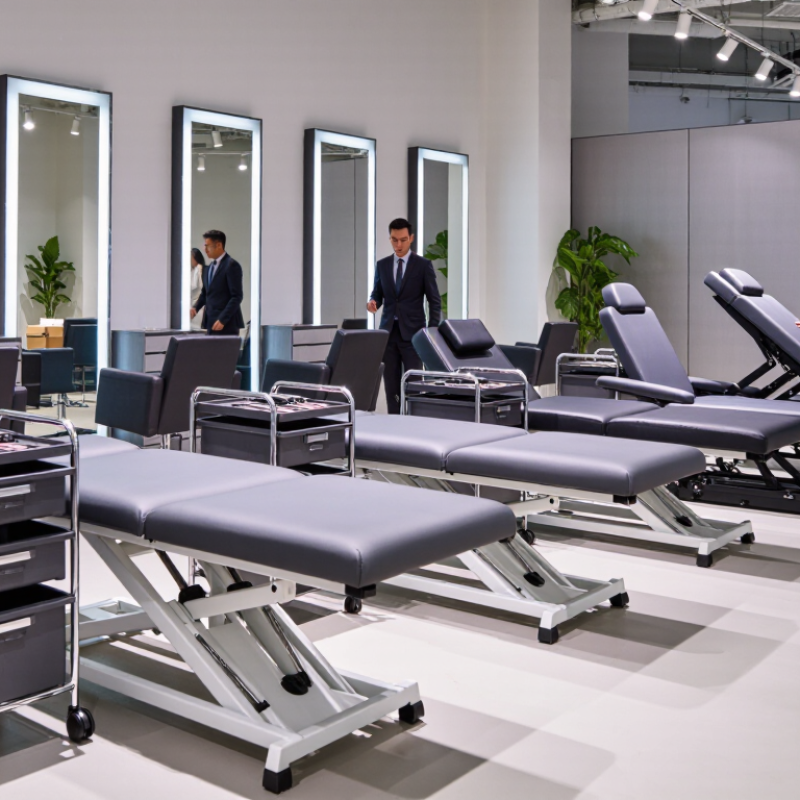
Lash furniture is the working setup around an artist and client: an adjustable treatment bed, a supportive stool, task lighting, a rolling trolley, and clean storage for tools and linens. Each piece shapes the service. A bed that stays steady helps the client remain still during detailed work; a stool that adjusts easily helps the artist reach the lash line without leaning across the client. Small details matter.
The U.S. Bureau of Labor Statistics projected 10% employment growth for skincare specialists from 2023 to 2033. Lash work is not reported as a separate occupation in that projection, so the figure is context, not a lash-industry forecast. Still, it points to a growing need for practical studio setups. In a compact room, a trolley beside the bed can keep supplies within reach, while a focused lamp reduces shadows around the eyes. Comfort is operational.
Furniture also affects cleaning and daily workflow. Smooth, wipeable surfaces and removable linens make reset between appointments more straightforward. Adjustable height can help different artists work at a more neutral posture, though one bed will not suit every body or room. I used to think storage capacity mattered most; in practice, clutter-free access and a stable bed may matter more. The BLS outlook is useful, but it cannot tell a studio exactly which furniture will fit its clients, space, or service routine.
What Lash Furniture Includes and How It Serves Beauty Studios
Common furniture categories and the practical functions each can serve in a lash studio.
Counts reflect the functions listed here, not market statistics; features vary by furniture design. A lash bed supports the client, positioning, and a cleanable work surface. A technician stool supports seated work and adjustable positioning. Task lighting helps illuminate and direct light onto the treatment area. A trolley keeps frequently used tools accessible and mobile. Storage cabinets organize supplies and keep them stored.
How the Global Lash Furniture Manufacturing Market Is Organized
The global lash furniture market is organized less like a single industry and more like a network of specialist suppliers. One factory may weld steel frames, while another cuts foam, sews washable upholstery, or assembles adjustable beds. A smaller group coordinates these parts and sells finished products to distributors, salon-equipment wholesalers, or directly to studios. Buyers should ask who controls the full process. A polished sample does not prove consistent production.
Grand View Research estimated the global furniture market at USD 736.7 billion in 2023, with projected growth through 2030. This broad category includes far more than lash beds, so it is useful context, not a lash-furniture market estimate. That distinction matters. Lash furniture is a narrow niche, shaped by practical details such as stable leg supports, smooth height adjustment, wipe-clean surfaces, and packaging that protects corners during shipping.
Manufacturers commonly serve different order profiles: standard models for quicker restocking, customized dimensions for studio layouts, and private-label production for larger buyers. Each option changes lead times, minimum quantities, and quality checks. Ask for written specifications, carton dimensions, load-test details, and photos of finished units before shipment. Requesting a sample can reveal stitching or wobble issues, though one sample cannot confirm every production run. The market is organized—but not always transparently.
China Top 10 Lash Furniture Manufacturers for Global Buyers - How the Global Lash Furniture Manufacturing Market Is Organized
| Market Segment | Typical Products | Common Manufacturing Setup | What Global Buyers Should Verify |
|---|---|---|---|
| 1. Lash Treatment Beds | Fixed-height and adjustable beds for eyelash extensions and other beauty treatments. | Upholstery, foam cutting, frame fabrication, and final assembly are commonly coordinated in one factory or across specialist suppliers. | Bed dimensions, load rating, adjustment mechanism, upholstery composition, and packaging protection. |
| 2. Electric Treatment Tables | Powered tables with electric height adjustment and, on some models, adjustable sections. | Furniture production is combined with purchased electrical components such as motors, hand controls, and power supplies. | Voltage and plug options, motor specifications, operating instructions, warranty terms, and applicable electrical compliance documents for the destination market. |
| 3. Manual Adjustable Beds | Beds with hand-operated backrests, leg sections, or height-adjustment features. | Metal linkages and hinges are assembled with upholstered sections; mechanisms may be sourced from component suppliers. | Adjustment range, hinge stability, pinch-point design, cycle testing, and availability of replacement parts. |
| 4. Lash Technician Stools | Height-adjustable stools, saddle seats, and rolling stools used by lash technicians. | Seat upholstery and chair-base assembly are often supported by standardized components such as gas lifts, casters, and metal bases. | Seat-height range, caster type, base stability, gas-lift specifications, and weight capacity. |
| 5. Technician Chairs with Backrests | Work chairs with back support, commonly offered with adjustable seat height and rolling bases. | Production typically combines an upholstered seat and backrest with a purchased chair mechanism and base. | Backrest adjustment, seat dimensions, base materials, assembly requirements, and replacement-component compatibility. |
| 6. Client Reception and Waiting Furniture | Waiting chairs, compact sofas, benches, and reception seating for lash studios and beauty salons. | Often produced as part of broader salon or commercial seating lines rather than exclusively for lash studios. | Commercial-use durability, upholstery cleaning guidance, fire-safety requirements where applicable, and carton dimensions. |
| 7. Lash Trolleys and Storage Units | Rolling carts, drawer units, and compact storage furniture for tools and consumables. | Manufacturing may involve sheet-metal, molded-plastic, or panel-furniture processes, depending on the design. | Drawer dimensions, wheel locks, surface-cleaning compatibility, assembly instructions, and spare-hardware supply. |
| 8. Made-to-Order and Private-Label Furniture | Customized colors, upholstery, dimensions, logos, or coordinated furniture sets. | Factories may adapt existing designs or develop new specifications; customization can affect tooling, sampling, and production lead times. | Written specifications, approved samples, minimum order quantities, artwork approval, ownership of custom tooling, and change-control procedures. |
| 9. Component and Contract Manufacturers | Frames, upholstered panels, metal bases, mechanisms, or complete products made to a buyer’s specification. | Some suppliers specialize in components or contract production instead of designing and selling a full retail range. | Factory capabilities, supplier traceability, inspection records, production capacity, and responsibility for final-product testing. |
| 10. Export-Oriented Finished-Goods Suppliers | Ready-to-order lash and Salon Furniture supplied in export packaging, sometimes with multiple model options. | May manage product sourcing, consolidation, export documentation, and shipment coordination in addition to manufacturing. | Whether production is in-house or subcontracted, inspection scope, Incoterms, export documents, packaging tests, and after-sales support. |
Buyer note: These are market segments and common operating models, not a ranked list of named manufacturers. Product specifications, factory capabilities, certifications, and export services vary by supplier and should be confirmed for each order.
Profiles of Ten Lash Furniture Manufacturers for Global Buyers
For global buyers, a useful manufacturer profile goes beyond a product photo. It shows what the factory makes, how it checks quality, and whether its communication is clear. These ten profiles represent different strengths to compare. A salon-focused producer may offer adjustable lash beds and compact stools. A metalworking specialist may build sturdy frames with smooth welds. A woodworking shop may provide warm finishes, though samples matter because colors can shift. An upholstery maker may offer wipe-clean surfaces and several foam densities.
A modular-furniture manufacturer can help buyers furnish small studios with matching pieces. A custom workshop may adjust dimensions, but changes can affect lead times. A high-volume factory may support larger orders and consistent specifications. Ask how it handles defects. A small-batch maker may suit trial orders, although its capacity can be limited. Check the details.
Two further profiles are worth considering. An export-oriented supplier may prepare clear packing lists and protective cartons; buyers should still confirm shipping terms directly. A design-led producer may offer distinctive shapes, but appearance alone does not prove comfort or durability. Request material specifications, assembly instructions, and close-up photos of joints and upholstery seams. If possible, inspect a sample under real studio conditions. One overlooked point: a chair that looks elegant in a showroom may feel awkward after a full workday.
How to Compare Product Quality, Range, and Customization
When comparing China’s top lash furniture manufacturers, look beyond polished catalog photos. Check frame materials, weld consistency, upholstery seams, and the stated load capacity. Ask for product dimensions and close-up images of joints and stitching. If possible, order a sample or inspect a finished unit before placing a large order. Small details matter. A smooth height adjustment and stable base can make a treatment bed easier to use throughout a busy day.
Tips: Compare the same product type across suppliers. Request a written specification sheet, packaging details, and a clear production lead time. Confirm whether listed accessories are included or priced separately.
A useful range may include treatment beds, stools, carts, lamps, and storage units. However, a large catalog does not guarantee consistent quality across every item. Customization can cover upholstery color, materials, dimensions, or logo placement, but changes may affect minimum order quantities and delivery schedules. Share a simple drawing or reference dimensions, then ask the manufacturer to confirm them in writing. Check how they handle defects and replacement parts, too. I would not judge a supplier from one attractive sample alone; that can miss differences between batches. Compare documented specifications and communication quality before deciding.
Key Factors in Sourcing Lash Furniture Internationally
International sourcing of lash furniture involves more than comparing catalog prices. Start with a written specification for bed dimensions, upholstery, frame materials, storage, and electrical components. Ask for close-up photos of joints, welds, stitching, and sealed edges. Small details matter. A finish that looks smooth in a sample may show scratches after repeated cleaning.
Request a pre-production sample or inspection photos before approving a large order. Check that drawers slide evenly and adjustable sections hold their position. Ask suppliers to document material specifications, quality checks, and packaging methods. For destination-market requirements, confirm the relevant documents with your importer or qualified adviser; requirements can differ. Ask for proof.
Clarify minimum order quantities, lead times, spare-part availability, and how damage claims are handled. Compare the full landed cost, including freight, duties, and protective packaging, rather than the unit price alone. Trade-offs happen. A lower quote may mean thinner padding or fewer inspection steps, but that should be verified, not assumed.
Keep communication in writing, and record approved dimensions, colors, and tolerances. One weakness in this process is that photos cannot fully show durability, so plan for independent inspection when order value or risk warrants it.