
>

What Is a Strip Light and What Types Are Available?

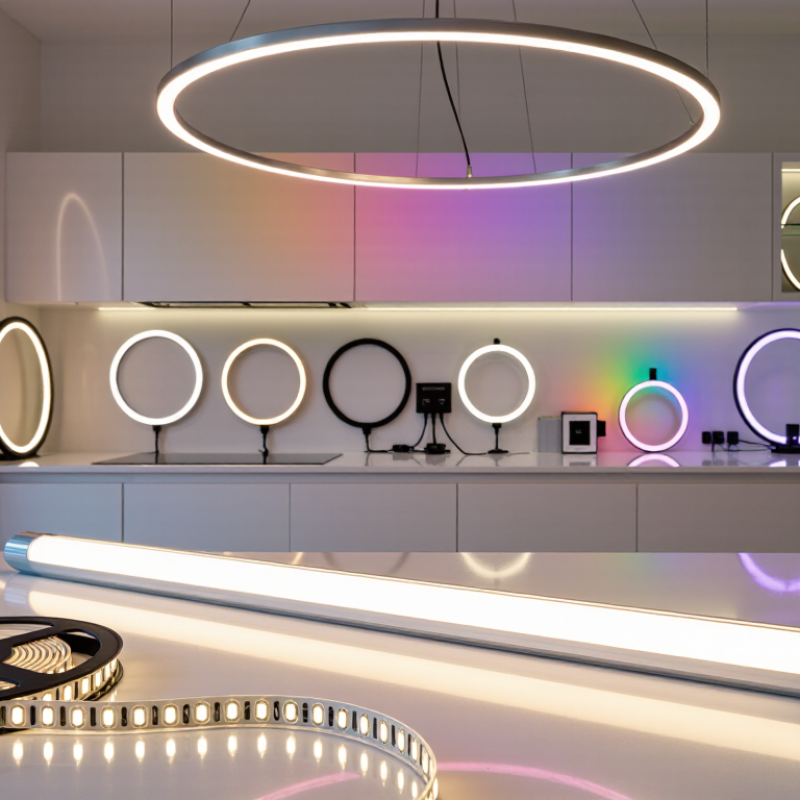
A Strip Light is a slim linear lighting product designed to place illumination where conventional fixtures may not fit. It can run beneath kitchen cabinets, trace a ceiling edge, or brighten a display shelf. That flexibility makes it useful, but the name covers products with very different construction and performance. Some use a flexible LED tape with adhesive backing; others use rigid bars or diffused neon-style tubing. Options also vary by color temperature, color-changing controls, brightness, and protection from dust or moisture.

Efficiency is one reason LED-based strip lighting has become widely considered. The U.S. Department of Energy’s Energy Saver guidance reports that LEDs use up to 90% less energy and can last up to 25 times longer than incandescent lighting. These figures describe LEDs broadly, not every Strip Light or installation. A product’s actual performance depends on its components, driver, operating temperature, and use. Specifications matter. Compare lumens per meter, watts per meter, color-rendering index, and the stated ingress-protection rating before choosing. A bright package claim alone tells little.

This guide explains what strip lights are and how common types differ, including single-color, tunable-white, RGB, and addressable models. It also considers where each type works best and what installation details deserve attention. Adhesive may weaken on dusty or warm surfaces; long runs can also show uneven brightness. Those practical limits are easy to overlook. The right choice depends on the room, desired effect, and power setup—not merely the lowest price.
What Is a Strip Light and What Types Are Available?

Definition and Basic Structure of a Strip Light

A strip light is a narrow, low-profile lighting assembly built around a flexible or rigid printed circuit board. Small LEDs sit along the board, while copper traces carry electrical current between them. In many constant-voltage strips, resistors divide the LEDs into repeating sections. Cut marks show where a section can be separated without breaking the circuit.

The basic structure also includes a backing layer, often with adhesive, and sometimes a clear protective coating. A power supply converts mains electricity to the voltage the strip requires; connectors join sections or feed power at multiple points. The U.S. Department of Energy’s 2020 U.S. Lighting Market Characterization reported that LEDs made up about 47% of installed U.S. lighting. That shift helps explain their broad use, but it does not mean every strip performs alike. LED spacing, board width, and heat removal all affect brightness and service life. Details matter.

In practical installation, the backing needs a clean, dry surface, and a narrow channel can help manage heat. Adhesive alone may not hold well on dusty paint or textured wood. I have seen this overlooked. Check the strip’s voltage, cut interval, and protection rating before choosing a location; a coated strip is not automatically suitable for every damp area. Finished strips also produce less light per watt than bare LED packages, because the circuit, coating, and heat all influence performance.

What Is a Strip Light and What Types Are Available?

Strip lights are flexible or rigid circuit boards fitted with closely spaced light-emitting diodes (LEDs). They are commonly used for accent, task, and decorative lighting.

Common LED Strip Light Densities

These are representative LED package densities available in commercial strip lights, not universal standards. A strip’s basic structure typically includes a circuit board, LED packages, electrical components, and an adhesive backing. Strip lights may also be categorized by color, such as single-color, tunable white, RGB, or RGBW.

How Strip Lights Produce and Distribute Light

An LED strip produces light when electrical current passes through tiny semiconductor chips mounted along a flexible circuit board. White strips commonly use blue LEDs and a phosphor layer to create white-looking light. The chips emit in set directions, so spacing and viewing angle affect whether the strip looks smooth or dotted. A diffuser can soften bright points, though it also reduces some output.

Light distribution depends on more than the LEDs. An aluminum channel helps manage heat, while its cover changes the beam and appearance. The U.S. Department of Energy’s 2022 Solid-State Lighting R&D Opportunities report sets a 250-lumens-per-watt efficacy goal for LED packages; this is a research target, not the delivered output of a finished strip. Drivers, wiring, heat, and diffusers all affect real-world performance. A bright rating alone can mislead.

Tips: Check lumens per meter and the test conditions. For a smooth glow under a cabinet, use a diffuser and place the strip where the LEDs are not directly visible. Even then, the result may look less uniform than expected.

Common Types of Strip Lights

Common Types of Strip Lights

Strip lights are flexible circuit boards carrying closely spaced light-emitting diodes. Their type affects color, brightness, installation, and appearance. Flexible LED strips bend around shelves or curved coves, while rigid bars suit straight cabinet runs. Cut marks show where trimming is safe; cutting elsewhere can damage a circuit. Small detail, big consequence.

Single-color strips produce one steady shade, commonly warm white, neutral white, or cool white. Tunable-white versions shift between warmer and cooler tones, useful when a kitchen needs clear task lighting by day and softer light at night. RGB strips mix red, green, and blue for changing colors. RGBW adds a dedicated white diode, which often gives cleaner white light than color mixing alone. It is not always the best choice for accurate color rendering.

COB strips place diodes close together, creating a more continuous line with fewer visible dots. Waterproof-coated strips are suited to damp locations, but the protection rating matters; a coating does not automatically make a strip suitable for immersion. The U.S. Department of Energy reports that LEDs use at least 75% less energy and last up to 25 times longer than incandescent lighting. Those figures describe LED lighting broadly, not every strip installation. Check the product’s power draw, heat limits, and dimmer compatibility before choosing.

Key Differences Among Strip Light Types

What Is a Strip Light and What Types Are Available?

Key Differences Among Strip Light Types

Strip lights are narrow circuit boards carrying small light-emitting diodes. Their differences affect brightness, color, installation, and heat. Flexible LED strips bend around shelves or curved edges, while rigid bars suit straight, stable surfaces. COB strips place LEDs close together, creating a smoother line of light with fewer visible dots. That can look cleaner under a kitchen cabinet.

Not always better. Some designs need careful heat management, especially in enclosed channels.

Color is another key difference. Single-color strips provide a consistent white or colored output. Tunable-white versions shift between warmer and cooler white, while RGB strips mix red, green, and blue light for changing colors. RGBW adds a separate white LED, which can produce more useful white light than color mixing alone. Check the voltage and power requirements before choosing; long runs may lose brightness toward the far end. Water-resistant coatings help in damp areas, but an IP rating does not make every strip suitable for direct water exposure. Cut only at marked points, and match the power supply to the strip’s voltage and wattage. A small mismatch can cause flicker or uneven brightness.

Typical Uses and Selection Factors

Strip lights are slim lighting assemblies, often built with LEDs on a flexible strip or inside a rigid bar. They suit under-cabinet work areas, closet shelves, display cases, and ceiling coves. Flexible strips can follow corners and shallow curves, while rigid bars give a straighter, more even line. Some models provide tunable white or color-changing light, but basic white versions are often more useful for daily tasks.

For a kitchen counter, check brightness and light spread, not just total wattage. A high-output strip can still leave dark patches if its LEDs are spaced far apart. Color temperature also matters: warm white feels softer, while neutral white can make food preparation and small details easier to see. Measure twice. Cut only at the marked points, and check whether the power supply and dimmer are compatible before installation.

Dust and moisture can affect performance near sinks or in covered outdoor spaces, so review the product’s stated protection rating for the actual location. A strip’s adhesive may not hold well on dusty, textured, or warm surfaces; a mounting channel can provide firmer support and help manage heat. Small details matter. Consider access to wiring, replacement options, and whether the light will be visible from normal viewing angles. Glare is easy to overlook on a screen, yet tiring when it shines directly into someone’s eyes.

What Is a Strip Light and What Types Are Available? — Typical Uses and Selection Factors
Category Type or factor Key characteristics Typical uses Selection guidance
Strip type Single-color LED strip Flexible circuit board with LEDs that emit one fixed color, commonly warm white, neutral white, cool white, or a single saturated color. Many models use 12 V or 24 V DC. Under-cabinet task lighting, shelves, coves, display cases, and simple accent lighting. Choose the desired color temperature for white light and check brightness, power consumption per metre, and compatible power-supply voltage.
Strip type RGB strip Red, green, and blue LED channels mix to produce a range of colors. Most require a compatible controller; RGB white is mixed from the color channels. Decorative lighting, entertainment areas, signage accents, and color-changing installations. Choose RGB when color effects matter more than high-quality white light. Confirm controller compatibility and whether the strip is analog or individually addressable.
Strip type RGBW strip Combines RGB color channels with a separate white LED channel, allowing dedicated white light as well as color effects. Rooms or displays that need both adjustable colors and useful white illumination. Check the dedicated white channel’s color temperature and output, plus the controller’s support for the strip’s channel arrangement.
Strip type Tunable-white strip Uses separate warm-white and cool-white LED channels to vary the white-light color temperature. The available range depends on the product. Living spaces, hospitality settings, and work areas where warmer or cooler white light is useful at different times. Check the stated color-temperature range, dimming method, controller requirements, and color consistency across the installation.
Strip type COB LED strip Chip-on-board LEDs are arranged closely to create a more continuous-looking line of light than widely spaced individual LED packages. Visible lines of light, shallow channels, furniture details, and applications where discrete light points are undesirable. Compare light output, color quality, power per metre, and thermal requirements. A diffuser can still improve appearance and reduce glare.
Strip type Addressable LED strip Individual LEDs or small LED groups can be controlled separately to create moving patterns and pixel effects. Requires a compatible controller and data connection. Architectural effects, displays, event installations, and animated decorative lighting. Confirm the control protocol, data direction, controller capacity, power-injection needs, and whether the strip uses 5 V, 12 V, or another specified supply.
Strip type LED neon-flex strip LEDs inside a flexible diffusing jacket create a smooth, neon-like line. Bending direction and minimum bend radius vary by construction. Contours, lettering, architectural outlines, and decorative lines where a continuous glow is preferred. Check the permitted bend direction, cut points, mounting method, brightness, and stated indoor or outdoor protection rating.
Selection factor Brightness and LED density Light output is commonly specified in lumens per metre; LED density is often stated as LEDs per metre. Neither value alone indicates the final brightness of an installation. Task lighting generally needs more useful output than subtle decorative or indirect lighting. Compare lumens per metre and beam or diffuser effects. Higher density can make the line look more even, especially in shallow channels.
Selection factor Color quality White strips are specified by correlated color temperature (CCT), in kelvins. Color rendering index (CRI) indicates how faithfully colors appear under the light. Warm residential ambience, neutral everyday lighting, or color-sensitive display and work areas. Choose CCT for the desired appearance; consider CRI of 90 or higher where accurate color rendering is important, and check the product’s stated rating.
Selection factor Voltage and power supply Low-voltage strips commonly operate at 5 V, 12 V, or 24 V DC. The power supply must match the strip’s voltage and provide adequate capacity. All installations, with voltage and supply choice affecting wiring, run length, and system layout. Calculate total load from watts per metre multiplied by installed length, then allow suitable headroom as specified by the supply manufacturer. Do not connect a low-voltage strip directly to mains power.
Selection factor Run length and voltage drop Voltage can fall along a long strip or undersized cable, causing reduced brightness or uneven color. The effect depends on strip design, voltage, wiring, and load. Long cabinet runs, room perimeters, and larger installations. Follow the manufacturer’s maximum run length. For longer runs, use appropriately sized wiring and power injection or multiple feeds where recommended.
Selection factor Ingress protection (IP) rating IP ratings describe protection against solid objects and water under specified test conditions. IP20 is generally for dry indoor use; higher ratings may offer protection against dust or water, depending on construction. Dry interiors, areas exposed to splashes, or outdoor locations when the complete installation is suitably rated. Match the rating to the actual environment and check connectors, end caps, and cut sections too. A strip’s rating alone does not make an unsealed installation waterproof.
Selection factor Dimming, controls, and compatibility Strips may use different dimming methods, controllers, connectors, and control protocols. Not every dimmer or controller works with every strip. Installations requiring dimming, color adjustment, schedules, or integration with a lighting-control system. Verify compatibility among the strip, controller, power supply, and dimmer before purchase; check whether the system supports the desired control method.
Selection factor Mounting, heat, and cutting LED strips are commonly mounted with adhesive backing or in channels. Aluminum channels can provide a mounting surface and help manage heat; cutting is usually limited to marked points. Cabinet undersides, coves, shelves, furniture, and custom-length installations. Use a clean, suitable surface and follow the stated cutting marks. Provide the recommended thermal management, and use a diffuser when a softer or more uniform line is needed.

Newsletter

Keep up on our always evolving product features and technology. Enter your e-mail and subscribe to our newsletter.