How to Source Cornmeal Puffs Globally in 2026?
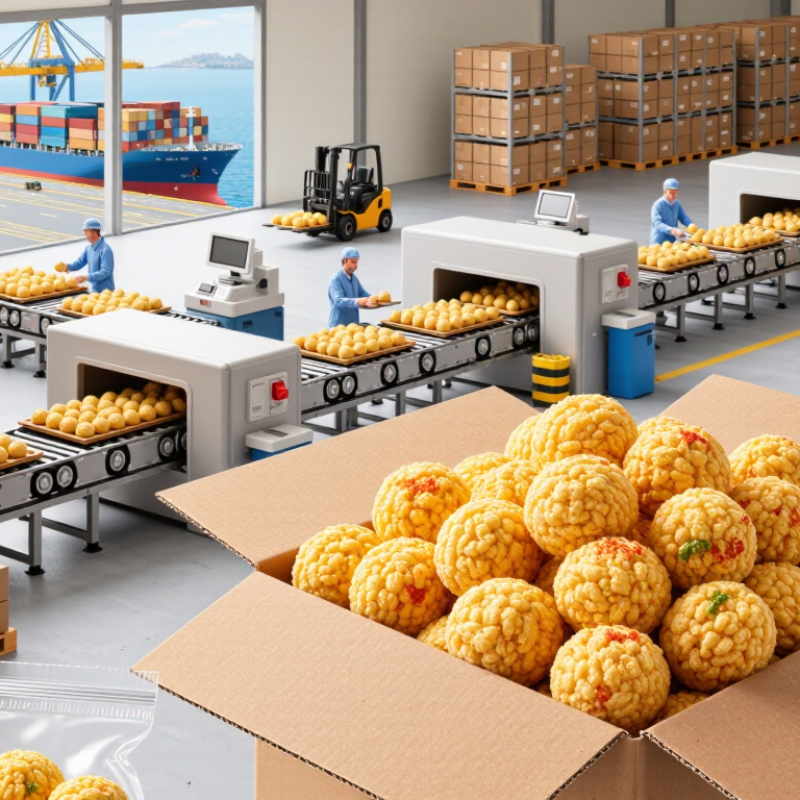
Sourcing Cornmeal Puffs globally in 2026 requires more than comparing supplier prices. Buyers must examine ingredients, processing methods, certifications, packaging, and delivery performance. A reliable sourcing plan begins with a clear product specification. Define corn variety, puff size, texture, seasoning, moisture level, and acceptable breakage rates. Small details matter. One damaged carton can weaken a retail launch.
Experienced buyers should request recent samples before signing supply agreements. Compare aroma, crunch, color, and consistency after opening each bag. Laboratory checks can verify allergens, microbial safety, moisture, and nutritional claims. Supplier audits add confidence, especially when production occurs far from the final market. Look for documented traceability from corn intake to finished cartons. Independent certification may support claims about food safety, ethical production, or responsible packaging.
Global logistics also deserves careful planning. Cornmeal Puffs may lose freshness during humid sea transport. Use moisture-resistant inner bags, strong cartons, and verified pallet loading. Confirm shelf-life data under realistic storage conditions, not only ideal warehouse temperatures. Customs documents, labeling rules, language requirements, and import duties must be checked for every destination. Regulations change.
A practical sourcing strategy should balance cost, resilience, and product quality. One supplier may offer attractive pricing but lack backup capacity. Another may provide excellent quality with longer lead times. That trade-off needs honest review. Forecasts can be wrong, particularly during harvest fluctuations or freight disruptions. Flexible contracts, dual sourcing, and safety stock can reduce exposure. Still, no plan removes every risk. The strongest approach combines supplier evidence, sensory testing, transparent communication, and continuous reassessment throughout 2026.
Defining Cornmeal Puffs and Global Sourcing Requirements
Cornmeal puffs are lightweight, expanded snacks made by extruding milled corn with heat and pressure. They are not popcorn. Buyers should define corn type, particle size, expansion ratio, moisture, color, texture, and seasoning separately. A practical specification may require crispness, low breakage, and moisture below 4% after packing. These details affect freight weight, shelf life, and consumer acceptance.
Global sourcing needs more than a low quotation. The OECD-FAO Agricultural Outlook 2024-2033 projects global maize production to approach 1.4 billion tonnes by 2033. That volume supports supply, but quality still varies by harvest, storage, and milling system. The FAO Food Outlook highlights continuing exposure to cereal price and logistics changes. Therefore, buyers should qualify at least two origins and compare crop calendars, port access, energy costs, and currency risk. Codex CXS 153-1985 can support maize quality discussions, while ISO 22000-based controls help verify food safety systems. Certificates alone are not enough. On-site or independent testing remains important.
Tips: Request pre-shipment samples from three production lots. Test moisture, bulk density, breakage, rancidity, and microbial results. Check allergen controls and packaging performance in humid conditions. Use retained samples for arrival comparisons. My caution is simple: a perfect sample can hide inconsistent production. Recheck every season.
Identifying Suitable Producing Regions and Potential Suppliers
How to Source Cornmeal Puffs Globally in 2026?
In 2026, sourcing cornmeal puffs starts with the production region, not the lowest offer. Reliable areas usually combine steady maize supply, extrusion expertise, dry storage, and practical export logistics. Useful candidates include the United States Midwest, Mexico, Argentina, Serbia, Hungary, and South Africa. Each region needs separate verification. Crop quality can change sharply between harvests. Rainfall, fumonisin risk, energy costs, and port access may affect real landed cost.
Potential suppliers fall into three groups: corn processors, snack extruders, and contract manufacturers with private-label capacity. Ask for recent certificates of analysis covering moisture, particle size, mycotoxins, pesticide residues, and microbiological results. Request a traceability map from farm intake to finished package. An on-site audit should examine silo hygiene, allergen controls, metal detection, batch coding, and recall procedures. Video calls help, but they do not replace evidence.
Sample testing should compare expansion, crunch, density, color, and flavor after three months in normal packaging. Run a small pilot before agreeing to annual volume. Specify corn variety, grind size, seasoning limits, packaging barrier, minimum order, lead time, and delivery terms in writing. Do not trust polished samples alone. I would not treat one successful batch as proof of supply readiness. That assumption deserves challenge. Humidity, inconsistent extrusion, or weak documentation can quickly damage an otherwise promising program.
Evaluating Ingredients, Quality Standards, and Product Certifications
Global cornmeal puff sourcing in 2026 requires more than comparing prices. Ingredient control often determines product safety, texture, and shelf stability. Ask suppliers for corn origin, milling date, moisture limits, and storage conditions. A clear specification should define particle size, color, flavor, and permitted processing aids. I also request a recent certificate of analysis for every production lot.
Quality verification should cover mycotoxins, pesticide residues, heavy metals, allergens, and microbiological risks. Testing frequency must match the ingredient’s origin and risk profile. Inspect the facility, not only the paperwork. Clean silos, sealed packaging, calibrated scales, and temperature records provide useful evidence. Small details matter. A slightly stale corn aroma can reveal poor stock rotation before laboratory results arrive.
For finished puffs, evaluate expansion, crunch, oil absorption, breakage, and package sealing. Independent laboratories can confirm nutritional values and contaminant results. Food safety systems such as HACCP or ISO 22000 may support supplier approval, but certificates need scope and validity checks. They are not automatic proof of every product’s quality. In my sourcing work, I have trusted documents too quickly at times. That mistake taught me to compare audits, test results, and physical samples together. Certification for allergen control, organic status, or export compliance should match the destination market. Requirements differ globally, and assumptions create expensive delays.
How to Source Cornmeal Puffs Globally in 2026? – Evaluating Ingredients, Quality Standards, and Product Certifications
Global sourcing reference table for ingredient selection, compliance review, supplier qualification, and product quality control.
| Evaluation area | Recommended sourcing specification | Practical target or requirement | Verification method | Why it matters for cornmeal puffs |
|---|---|---|---|---|
| Primary cereal ingredient | Degerminated or partially degerminated yellow or white maize meal, depending on the desired color and flavor profile. | Food-grade material with a documented specification for particle size, moisture, foreign matter, and mycotoxins. | Supplier specification, certificate of analysis, representative sample, and approved-laboratory testing. | The maize fraction determines flavor, color, expansion behavior, bite, and much of the product’s nutritional profile. |
| Moisture of incoming meal | Dry, free-flowing cornmeal suitable for extrusion or other puffing processes. | Typically controlled near 12–14% for storage and process consistency; the final limit must follow the processor’s validated formulation. | Validated moisture analyzer or oven method; test each lot or according to the risk-based sampling plan. | Excess moisture can reduce expansion and shorten shelf life, while overly dry meal can affect feeding and texture. |
| Particle-size distribution | Consistent meal or grits grade matched to the extruder, die, and target puff structure. | Use a supplier-defined sieve profile; avoid unexplained lot-to-lot shifts in fine and coarse fractions. | Sieve analysis, retained-sample comparison, and pilot extrusion trial. | Particle size influences hydration, residence time, expansion, cell structure, and surface roughness. |
| Mycotoxin control | A documented maize-risk program covering aflatoxins, fumonisins, deoxynivalenol, and other hazards relevant to the origin and destination market. | Results must comply with the legal maximum levels of the importing market; limits differ by jurisdiction and product category. | Accredited-laboratory testing using validated methods such as LC-MS/MS or recognized rapid screening followed by confirmation. | Maize is a recognized risk commodity, and contamination may occur before processing. |
| Microbiological safety | Supplier controls for Salmonella, pathogenic microorganisms, indicator organisms, and environmental hygiene. | Finished product must meet the microbiological criteria applicable to the destination market and product type. | Risk-based testing, sanitation records, environmental monitoring, and finished-product release procedure. | Low-moisture snacks are generally stable but can still be contaminated after thermal processing. |
| Oil and fat system | Refined edible oil or other permitted fat selected for neutral flavor, oxidation stability, and regional labeling requirements. | Specify fatty-acid profile, peroxide value, free fatty acids, allergen status, and permitted use conditions. | Certificate of analysis, incoming inspection, supplier audit, and accelerated shelf-life assessment. | Oil affects flavor carry, crispness, rancidity risk, nutrition claims, and label declarations. |
| Seasoning and additives | Salt, sugar, spices, acids, colors, and processing aids that are legally permitted in the destination market. | Every additive must have an identity, functional class, usage limit where applicable, and traceable lot documentation. | Formula review, allergen and cross-contact assessment, regulatory check, and finished-label verification. | Seasonings often introduce allergens, sodium variability, color differences, and additional import requirements. |
| Allergen management | Cornmeal itself is not one of the major allergens recognized in every jurisdiction, but seasonings and shared equipment may introduce allergens. | Maintain an ingredient allergen matrix and declare allergens according to the destination country’s rules. | Supplier questionnaires, validated cleaning controls, label review, and targeted testing when justified by risk. | Undeclared allergens can cause recalls, border delays, and serious consumer harm. |
| GMO status | Choose conventional, identity-preserved non-GMO, or genetically modified material according to the target market and customer brief. | Define the applicable legal threshold, segregation controls, and documentary evidence before purchase. | Identity-preserved records, supplier declarations, chain-of-custody documents, and risk-based PCR testing. | GMO labeling and market acceptance requirements vary significantly across countries. |
| Food-safety certification | Prefer a current, independently audited GFSI-recognized certification such as BRCGS, FSSC 22000, or SQF where available. | Verify certificate scope, site address, product category, expiry date, and audit status. | Certificate-body database check, audit report review, corrective-action review, and supplier approval audit. | Certification supports systematic control of hazards, traceability, sanitation, and corrective actions. |
| HACCP and preventive controls | A documented hazard analysis covering receiving, milling, extrusion or baking, seasoning, cooling, packing, and distribution. | Critical limits, monitoring frequency, verification activities, deviation handling, and record retention must be defined. | HACCP plan review, on-site audit, process records, calibration records, and mock-recall exercise. | Puff production can involve thermal, foreign-material, allergen, and post-process contamination hazards. |
| Final moisture and water activity | Crisp, shelf-stable product with packaging and process controls suited to the expected distribution climate. | Set validated release limits; many expanded snacks target water activity below 0.60, but the exact limit must be product-specific. | Calibrated water-activity meter, moisture test, texture check, and shelf-life study. | Water activity is closely linked to crispness, microbial stability, and moisture migration. |
| Sensory and physical quality | Uniform puff size, light and crisp texture, clean corn flavor, consistent seasoning adhesion, and absence of burnt or stale notes. | Establish a golden sample, defect catalogue, breakage tolerance, color range, and sensory scoring procedure. | Pre-shipment sample approval, line inspection, texture measurement where available, and retained-sample comparison. | Consumer acceptance is strongly affected by crunch, expansion, appearance, and flavor consistency. |
| Foreign-material control | Screening, magnets, sieves, metal detection, and, where appropriate, X-ray inspection throughout the process. | Use documented equipment sensitivity checks and investigate every confirmed or suspected failure. | Preventive-maintenance records, challenge tests, inspection logs, and corrective-action reports. | Maize handling and high-speed packaging can introduce stones, metal, hard plastic, or other foreign material. |
| Packaging barrier | Moisture- and oxygen-barrier packaging appropriate for the intended shelf life and shipping conditions. | Validate seal strength, leak resistance, oxygen transmission, water-vapor transmission, and pack integrity. | Packaging specification, seal testing, transport simulation, and real-time or accelerated shelf-life study. | Poor barrier performance quickly causes loss of crunch and oxidation of the fat phase. |
| Traceability and recall readiness | Lot-level traceability from maize origin and ingredients through processing, packaging, shipment, and customer delivery. | Supplier should demonstrate one-step-back and one-step-forward traceability and conduct periodic mock recalls. | Traceability exercise, batch records, mass-balance review, and recall procedure audit. | Fast lot identification limits the scope and cost of a potential withdrawal or recall. |
| Import and labeling readiness | Confirm ingredient nomenclature, nutrition declaration, allergen statement, net quantity, date marking, origin rules, and language requirements. | Review the final label against the current rules of every intended sales market before production or shipment. | Regulatory assessment, nutrition calculation or laboratory analysis, artwork approval, and customs-document review. | A compliant product can still be detained or rejected if its label or import documentation is incomplete. |

Comparing Costs, Packaging Options, Shipping Routes, and Trade Terms
How to Source Cornmeal Puffs Globally in 2026?
Global sourcing starts with a comparable product specification, not the lowest quotation. Request moisture limits, puff size, seasoning details, shelf life, and annual capacity. A practical cost sheet should include corn inputs, processing, packaging, laboratory testing, freight, insurance, duties, and inland delivery. Small omissions become expensive surprises.
Packaging affects both protection and landed cost. A high-barrier pillow bag can protect crisp texture during humid voyages. Cartons need strong compression resistance for stacked containers. Nitrogen flushing may improve freshness, but it adds equipment and quality-control expenses. Recyclable structures look attractive, yet their barrier performance requires verification. Ask for drop tests, seal checks, and migration documentation.
Shipping choices depend on volume and urgency. Ocean freight usually suits full containers, while rail can support some inland routes. Air freight works for samples, not routine replenishment. Compare direct sailings with transshipment routes because delays can disrupt retail launch dates. FOB offers buyer control after loading, while CIF includes freight and insurance to the destination port. DDP may simplify delivery, but customs responsibilities and local taxes must be clearly confirmed. My early comparison would have focused too heavily on unit price. That was a mistake. Packaging weight, port storage, currency movement, and rejected cartons can change the real cost quickly. Supplier audits and pre-shipment inspections remain worthwhile, even when schedules feel tight.
Managing Import Compliance, Quality Control, and Supplier Relationships
Sourcing cornmeal puffs globally in 2026 requires more than comparing prices. Import compliance should guide every supplier decision. Request ingredient declarations, allergen statements, nutrition data, certificates of analysis, and manufacturing licenses before negotiations advance. Check the destination market’s labeling, packaging, shelf-life, and food-contact requirements with a qualified customs specialist. Rules can change. Do not rely on an old checklist.
Quality control should begin with a written product specification. Define puff size, color, texture, moisture, seasoning intensity, breakage tolerance, and microbial limits. Ask for representative samples from several production lots, not one carefully selected carton. Test moisture and texture after simulated shipping conditions. A crisp puff can become soft inside a humid container. That detail is easy to miss. Independent laboratory testing adds confidence, although it increases cost and time.
Tips: Use a supplier scorecard covering compliance history, batch consistency, response speed, capacity, and corrective actions. Keep sealed samples from each approved shipment. Record container temperature, arrival condition, and complaints with photographs. Build relationships through regular video audits and clear forecasts, but keep performance terms in writing. A supplier may promise flexibility during a call, then struggle during peak demand. Honest reviews matter. If a recurring defect appears, investigate the process together before demanding a discount. This approach protects quality while leaving room for practical improvement.