
7 Dry Land Music Fountain Buying Tips for Global Buyers
A Dry Land Music Fountain can turn a paved plaza into a lively public attraction. It can also become a costly maintenance challenge if key details are missed. Global buyers should look beyond the renderings. The equipment beneath the grating matters just as much as the water choreography above it.
For transparency, the expert name and quotation below are illustrative, not a verified statement from a real professional. Fictional fountain systems specialist Daniel Mercer offers this guiding line: “Buy the drainage plan before you buy the water show.” It is a useful reminder. Ask how quickly water returns to the collection tank after a performance. Check grating materials, surface grip, pump access, and emergency shutoff arrangements. A beautiful sequence is less impressive when puddles remain around the nozzles.
These seven buying tips will help international purchasers compare proposals with greater care. Review the number and spacing of jets, lighting options, control systems, and sound equipment. Confirm that the supplier explains installation needs, spare parts, commissioning, and local service support. Shipping distance can affect lead times and replacement costs. So can climate. Dust, heat, freezing temperatures, and heavy rainfall may change equipment requirements. Request drawings and clear performance specifications. Then ask who handles testing after installation. Details can still be overlooked, even by experienced teams. That is worth admitting early. Careful questions cannot remove every project risk, but they can reveal gaps before contracts are signed and concrete is poured.
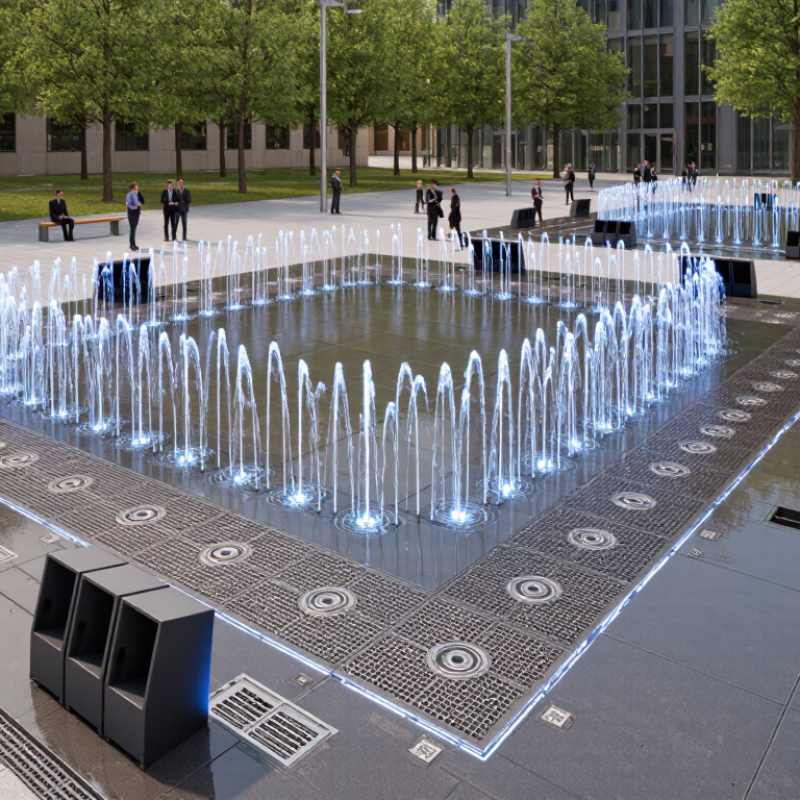
Define the System: Flush Jets, Grates, and Recirculating Water
A dry-land music fountain is not simply a pool without water. Its design depends on flush-mounted jets, load-rated grates, drainage, and a dependable recirculation loop. Ask suppliers for a cross-section drawing showing how each component fits beneath the paving. Small details matter. Flush jets should sit level with the surface when inactive, keeping the plaza usable between shows. Check that removable covers allow access to nozzles and pipes without lifting large sections of stone.
Grates must carry the expected pedestrian load, including maintenance carts where applicable. Request documented load ratings and installation details, then have a qualified local engineer review them. Water needs an intentional route. Specify paving slopes, channel drains, and overflow capacity for heavy rain and routine washdown. Check grate openings against footwear, mobility aids, and cleaning tools; even a narrow slot can collect debris.
Size the recirculation tank for operating volume, splash loss, and local climate, not appearance alone. Ask how filters, pumps, and valves can be reached without closing a large area. Clarify whether controls can pause jets during maintenance or windy conditions. Treatment and replacement schedules vary with climate and use, so request written operating assumptions. Drawings may look tidy. Field conditions rarely do. A paving sample can reveal splash, noise, and drainage issues that plans miss.
7 Dry Land Music Fountain Buying Tips for Global Buyers - Define the System: Flush Jets, Grates, and Recirculating Water
| Buying Tip | System Element | What to Specify | What to Verify Before Purchase |
|---|---|---|---|
| 1. Define the installation type | Flush jets and deck layout | Confirm whether the project uses flush-mounted nozzles in a paved deck, a covered reservoir below the deck, or another arrangement. State the finished paving level and the intended spray height and pattern. | Request coordinated drawings showing nozzle locations, access panels, pipe routes, drainage points, and the relationship between the fountain and surrounding pavement. |
| 2. Specify grates and walking surfaces | Deck grates, slots, and paving | Identify the materials, finish, load requirements, and intended pedestrian use. Grate openings and surface details should be selected to suit local accessibility, slip-resistance, and safety requirements. | Ask for product data and project-specific details for load capacity, corrosion resistance, surface finish, installation, and safe access for maintenance. Confirm applicable local codes with the design team. |
| 3. Design the recirculating water loop | Reservoir, pumps, and pipework | Provide a hydraulic design based on nozzle flow, operating sequence, pipe losses, reservoir volume, and the number of effects running at the same time. State the expected operating schedule. | Request pump duty points and system calculations rather than selecting a pump by motor rating alone. Check that the design includes suitable water-level control, make-up water, overflow, and drain arrangements. |
| 4. Plan water quality and filtration | Filters, treatment, and water management | Specify filtration and water-treatment provisions appropriate to the water source, climate, usage, and local health and environmental requirements. | Confirm how filters are accessed and cleaned, how water quality is monitored, and how treatment, backwash, and discharge are managed. Establish a maintenance plan with the supplier. |
| 5. Coordinate music, lighting, and controls | Show control and electrical systems | List the required audio inputs, lighting effects, show sequences, operating modes, and control interfaces. Identify the power supply and communication requirements for the project location. | Request an interface schedule and a sequence-of-operations document. Have qualified local professionals verify electrical protection, bonding, earthing, and installation against applicable regulations. |
| 6. Check drainage and climate conditions | Site drainage and seasonal operation | Provide site information such as rainfall, ambient temperature range, wind exposure, groundwater conditions, and any freeze or seasonal shutdown requirements. | Confirm where splash water and stormwater go, how the area drains when the fountain is off, and what procedures are needed for shutdown, winterization, or restart. |
| 7. Compare lifecycle support | Access, spare parts, and documentation | Include routine inspection, cleaning, filter service, pump access, consumables, and expected operating needs in the ownership plan. | Request as-built drawings, equipment schedules, operation and maintenance manuals, recommended spare parts, warranty terms, and a clear process for technical support. |
Planning note: Final equipment sizing, grate selection, drainage design, and safety provisions depend on the site, local codes, and the completed hydraulic and electrical designs.