
10 Best Wall Mounted Display Racks for Retail Stores
Wall space can do more than hold products; it can guide shoppers through a store. The right Wall-Mounted Display Racks keep popular items visible, free up floor space, and make restocking easier. But a rack that looks neat in a product photo may feel awkward beside a narrow aisle or crowded checkout counter. Details matter.
This guide explores ten options, from pegboard panels and slatwall shelves to wire grids and clear acrylic ledges. Each suits different merchandise. Peg hooks can organize packaged accessories, while sturdy shelves may work better for folded goods or small boxes. Check dimensions, stated load limits, mounting hardware, and wall type before choosing. A rack is only as dependable as its installation.
Think about daily use, too. Can staff reach the top shelf without stretching? Are price labels easy to see? Will items stay put when customers browse? These questions sound small. They are not. A visually striking display can still create clutter or slow replenishment, and no single rack fits every shop. That part is easy to overlook. The recommendations ahead focus on practical features, materials, and store needs, while recognizing that real layouts vary. Use them as a starting point, then compare each option with your merchandise and available wall space.
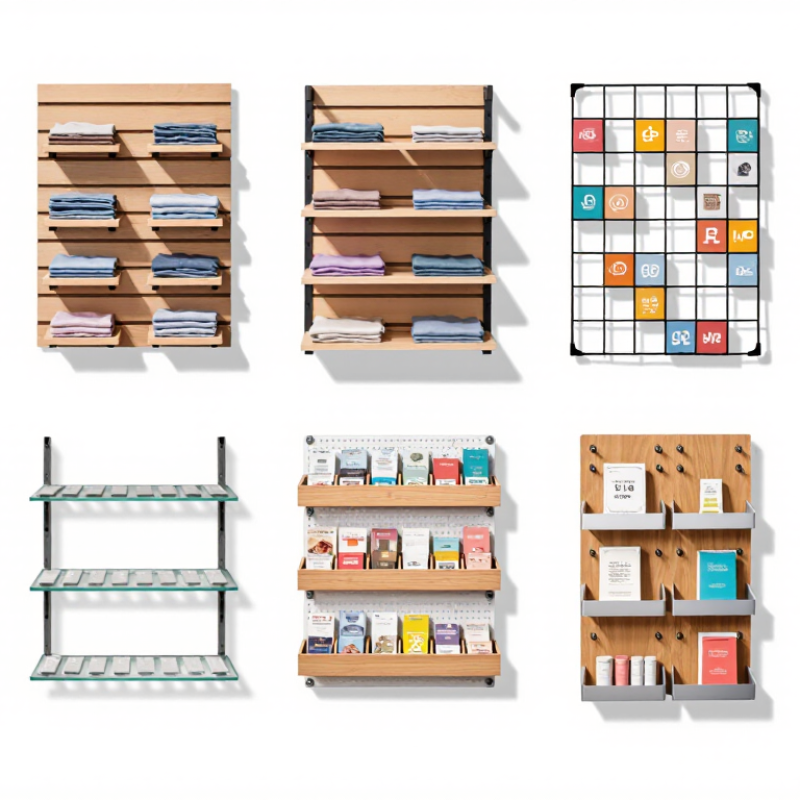
What Wall-Mounted Display Racks Are and How Retailers Use Them
Wall-mounted display racks are fixtures secured to a wall or slatwall, freeing floor space while keeping products visible and reachable. Retailers use shelves, hooks, and brackets to present items such as folded shirts, small accessories, or packaged goods. A useful layout groups related products together: a shopper can compare sizes on nearby hooks, then find matching accessories below. Keep frequently handled items within comfortable reach, and leave enough space for labels and price tags. Small details matter. A crooked shelf or crowded hook row can make even good merchandise hard to assess.
The U.S. Census Bureau’s Quarterly Retail E-Commerce Sales report estimated that online sales represented 16.1% of total U.S. retail sales in the fourth quarter of 2024. That figure describes shopping channels, not the sales impact of wall racks; it should not be treated as proof that a fixture increases purchases. Still, physical stores need clear ways to present products customers can inspect in person. Match rack depth and spacing to the actual product, and check the wall’s support and the fixture’s rated load before installation. A display may look tidy when empty. It can behave differently once fully stocked, so review it during normal store use.
Wall-Mounted Display Racks: Shelf Projection Options
Compare practical shelf depths when planning a wall-mounted retail display.
These measurements are example shelf-depth options, not sales or market-share figures. Retailers can choose a projection that suits the products while preserving aisle space. Check the fixture’s rated load and available sizes before installation.
Common Rack Types and Their Retail Applications
Wall-mounted display racks suit different products and shopping behaviors. Slatwall panels accept movable hooks and shelves, making them useful for accessories, packaged goods, and seasonal displays. Pegboard offers similar flexibility, but heavier items need correctly rated hooks. Gridwall works well for lightweight products and open layouts, especially where staff need to change displays often. Keep it visible.
For folded clothing, boxed goods, or small homewares, fixed shelves create a clear, layered presentation. Lockable wall cabinets can protect compact, higher-value items while keeping them in sight; they should not replace sensible staff supervision. The National Retail Federation’s 2023 National Retail Security Survey reported an average inventory shrink rate of 1.6% of sales among respondents for 2022. That figure is a planning signal, not proof that display hardware alone prevents losses.
Placement matters as much as rack type. Put frequently chosen items near eye level, leave enough space for hands and product labels, and keep heavy stock lower. The U.S. Census Bureau reported that e-commerce represented 16.1% of U.S. retail sales in the fourth quarter of 2024, meaning most sales still occurred in physical stores. A useful wall display should make comparison easy, not simply fill empty space. A crowded wall can look busy rather than inviting; I would review it from a shopper’s distance before adding another fixture.
| No. | Rack Type | Typical Configuration | Suitable Merchandise | Common Retail Applications | Key Advantages | Planning Considerations |
|---|---|---|---|---|---|---|
| 1 | Slatwall Panel System | Wall panels with horizontal grooves that accept compatible hooks, brackets, and shelves. | Apparel accessories, packaged goods, small electronics, homewares, and seasonal products. | General merchandise stores, gift shops, clothing stores, and changing promotional displays. | Accessories can be repositioned across the panel, making it easy to revise layouts and product groupings. | Confirm accessory compatibility and secure panels to suitable wall framing; account for the weight limits of panels and fittings. |
| 2 | Pegboard Display | Perforated board fitted with hooks, small shelves, or bins. | Tools, craft supplies, hardware, accessories, and lightweight packaged items. | Hardware shops, craft stores, hobby retailers, and back-of-store organization areas. | Offers a straightforward way to arrange many small products while keeping them visible and accessible. | Use hooks designed for the board and merchandise; heavier loads require suitable backing and secure wall attachment. |
| 3 | Wall-Mounted Rail and Bracket Shelving | Vertical standards or a horizontal rail support adjustable shelf brackets and shelves. | Folded clothing, boxed goods, footwear, books, and medium-weight household products. | Apparel stores, bookshops, specialty food shops, and stock-forward merchandise walls. | Shelf height and spacing can be adjusted to fit different product sizes and presentation needs. | Choose brackets and shelves rated for the intended load; install standards into appropriate structural supports. |
| 4 | Wire Grid Panel | Rigid wire grid fixed to a wall, with compatible hooks, baskets, and shelves. | Packaged accessories, toys, lightweight apparel, small household items, and impulse products. | Convenience stores, pop-up retail areas, seasonal sections, and compact shops. | Open grid construction keeps products visible and supports a range of interchangeable display accessories. | Check grid and accessory compatibility, keep loads within rated limits, and avoid sharp or unstable projections into aisles. |
| 5 | Wall-Mounted Peg Hook Rail | A fixed rail or back panel with hooks arranged in rows for hanging merchandise. | Blister-packed products, tools, cables, key rings, and other hang-tab merchandise. | Electronics accessory shops, pharmacies, hardware stores, and checkout-adjacent merchandising. | Supports clear product facing and makes small hanging items easy to browse and replenish. | Match hook length and spacing to package dimensions; ensure the rail and wall fixings can support the combined product load. |
| 6 | Wall-Mounted Wire Baskets | Open wire baskets attached directly to a rail, panel, or wall bracket. | Soft goods, packaged items, rolled products, and small products sold in quantity. | Discount stores, convenience retail, clearance sections, and merchandise overflow areas. | Provides quick access to loose or grouped items and allows airflow around merchandise. | Use baskets with appropriate depth and load capacity; consider dividers when products need to remain sorted. |
| 7 | Floating Display Shelves | Shelves supported by concealed or low-visibility wall brackets. | Decorative objects, folded apparel, small boxed products, and curated merchandise. | Boutiques, beauty retailers, gift shops, and feature or focal-point displays. | Creates a clean, uncluttered presentation that draws attention to selected products. | Check the shelf's load rating and wall construction; leave enough depth and spacing for safe product placement. |
| 8 | Wall-Mounted Faceout Arms | Short horizontal arms project from a wall rail or panel to display garments facing forward. | Shirts, jackets, dresses, and other garments on hangers. | Apparel stores, boutique walls, and displays highlighting a small product collection. | Shows garment fronts clearly and makes featured styles easy for shoppers to view. | Allow clearance for garments and customer movement; check arm capacity and fasten the supporting rail securely. |
| 9 | Wall-Mounted Waterfall Arms | Angled arm with multiple pegs or stops that present a sequence of hangers. | Clothing grouped by size, color, style, or coordinated outfit. | Apparel departments, fitting-room approaches, and compact wall merchandising zones. | Displays several garments in a compact footprint while helping shoppers scan a product range. | Keep garments within the arm's rated capacity and provide enough clearance so hangers can be removed easily. |
| 10 | Wall-Mounted Acrylic Ledge | Shallow transparent ledge or shelf with a raised front lip to help retain displayed items. | Books, magazines, greeting cards, cosmetics, small boxed products, and product samples. | Bookshops, beauty counters, galleries, and stores presenting covers or front-facing packaging. | Offers a neat, front-facing presentation with minimal visual obstruction. | Check the ledge depth and load rating, avoid overloading it, and use secure fixings suitable for the wall surface. |
Key Factors for Choosing a Wall-Mounted Display Rack
Choosing a wall-mounted display rack starts with the wall, not the merchandise. Check whether the surface is drywall, masonry, or another material, and locate suitable support points before choosing a rack. A fully loaded unit can weigh far more than it appears to. Follow the rack and fastener instructions, and ask a qualified installer when the wall structure is uncertain.
Measure the available width, height, and depth, then compare them with the products shoppers need to see. A narrow rack may suit packaged goods, while deeper shelves can hold bulkier items but project farther into the aisle. Keep frequently handled products within comfortable reach. Small details matter: a price label hidden behind a shelf edge can slow customers down. Test the layout with actual merchandise, not just empty fixtures.
Consider adjustability, finish, and cleaning access. Shelves that move can adapt when product sizes change, though too many configurations may make restocking less consistent. Smooth, durable surfaces are easier to wipe, especially near busy entrances. Check edges for snag points and make sure hooks or shelves cannot shift during normal use. One detail is easy to overlook: a display that looks balanced when empty may feel crowded once stock arrives. Leave room for products to be faced neatly.
Comparing the 10 Best Wall-Mounted Display Racks for Retail Stores
Comparing the 10 best wall-mounted display racks starts with the merchandise. Slatwall panels adapt quickly; gridwall is lighter and suits hooks or baskets. Pegboards offer flexible spacing, while fixed shelves hold heavier packaged goods. Floating shelves look clean but provide less adjustment. Acrylic ledges keep small items visible, though fingerprints show easily. Wire shelves improve airflow; garment rails display clothing without folding. Hook-and-basket systems suit accessories, while modular panels combine several formats. No single rack wins every aisle.
Compare load capacity, usable depth, installation method, and how often displays change. A wall that cannot support loaded shelving makes even a strong rack a poor choice.
The U.S. Census Bureau reported that e-commerce represented 16.1% of total U.S. retail sales in the second quarter of 2024, leaving most sales in physical retail. That makes clear, accessible in-store presentation consequential, though the figure does not prove a rack increases sales.
Measure the wall and test sightlines from the entrance. Small details matter.
One limitation: published capacity ratings rarely reflect uneven loading or repeated restocking. I would treat them as a starting point, not a guarantee.
Installation, Safety, and Maintenance Considerations
Wall-mounted display racks need more than a neat row of brackets. Confirm the wall type, locate studs or masonry, and choose anchors rated for the expected load. Include the weight of the rack, merchandise, and any force from customers reaching for products. Drywall alone is not a reliable fixing point. For heavy displays, have a qualified installer verify the fixing method and wall condition.
Safety checks matter in busy stores. The U.S. Bureau of Labor Statistics reported 3.3 recordable injury and illness cases per 100 full-time-equivalent workers in retail trade in 2023, compared with 2.4 across private industry. That figure covers many hazards, not racks alone, but it underscores the value of routine prevention.
OSHA’s 29 CFR 1910.176(b) says stored materials must be stable and secured against sliding or collapse. Keep heavier items low, distribute loads evenly, and leave aisles and exits clear.
Tips: Mark each rack’s load limit where staff can see it. Check brackets, anchors, and wall surfaces monthly; investigate loose screws, cracks, or a rack that shifts under light pressure. Clean spills promptly, and avoid hanging bags or cords where they can snag. A checklist helps, though it will not catch every problem.