
>

2026 Top TV Wall Cabinet Types for Global Buyers?

A television wall is no longer just a place to mount a screen. For many homes and hospitality projects, it also carries storage, hides cables, and sets the room’s visual tone. Grand View Research’s Global Furniture Market report estimated the market at USD 677.09 billion in 2023, with growth projected through 2030. This figure covers furniture broadly, not TV cabinets alone. Still, it signals the scale of a category where buyers increasingly compare function, finish, and value.

The right Tv Wall Cabinet depends on more than style. A floating unit can free floor space in a compact apartment, while a modular cabinet may suit a larger living room or a multi-unit project. Buyers should check cabinet dimensions against screen width, confirm the wall structure and mounting method, and allow airflow around electronic devices. Cable openings matter, too. A neat front can hide a tangle behind it.

Small details count.

For global buyers, product specifications deserve close attention. Ask suppliers for load ratings, material descriptions, finish samples, packaging details, and installation guidance. Compare those details across quotes, rather than relying on product images alone. Regional preferences, room sizes, and delivery requirements differ, so one design rarely suits every market. And honestly, even a well-planned cabinet can feel wrong if its depth or color clashes with the room. This guide explores leading TV wall cabinet types for 2026 and the practical trade-offs behind each choice.
2026 Top TV Wall Cabinet Types for Global Buyers?

How TV Wall Cabinets Are Classified for Global Buyers in 2026

For global buyers, TV wall cabinets are best classified by installation, storage, and configuration—not appearance alone. Wall-mounted or floating units leave floor space visible but need secure anchoring and careful cable planning. Floor-standing cabinets are easier to reposition and may suit rental homes. Modular systems combine shelves, closed cupboards, and display niches. The distinctions matter. A cabinet that looks spacious online may leave too little room for a soundbar or ventilation.

Statista Market Insights estimated the global furniture market at about US$766 billion in 2024. That figure covers furniture broadly, not TV wall cabinets specifically, so it should not be treated as category sales data. Still, it signals a large, varied market where buyers need clear specifications.

Compare overall width, usable shelf depth, load capacity, cable openings, and the wall type required for installation. Materials and finish also affect cleaning and wear; glossy surfaces show fingerprints more readily. One category remains blurry: “media console” and “TV cabinet” are often used interchangeably across markets.

Tips: Measure the screen, soundbar, and wall before ordering. Ask for internal dimensions and mounting details, not just product photos. Check how heat escapes from enclosed compartments. Small details matter. A few millimeters can change the fit.

Popular TV Wall Cabinet Types and Their Key Features

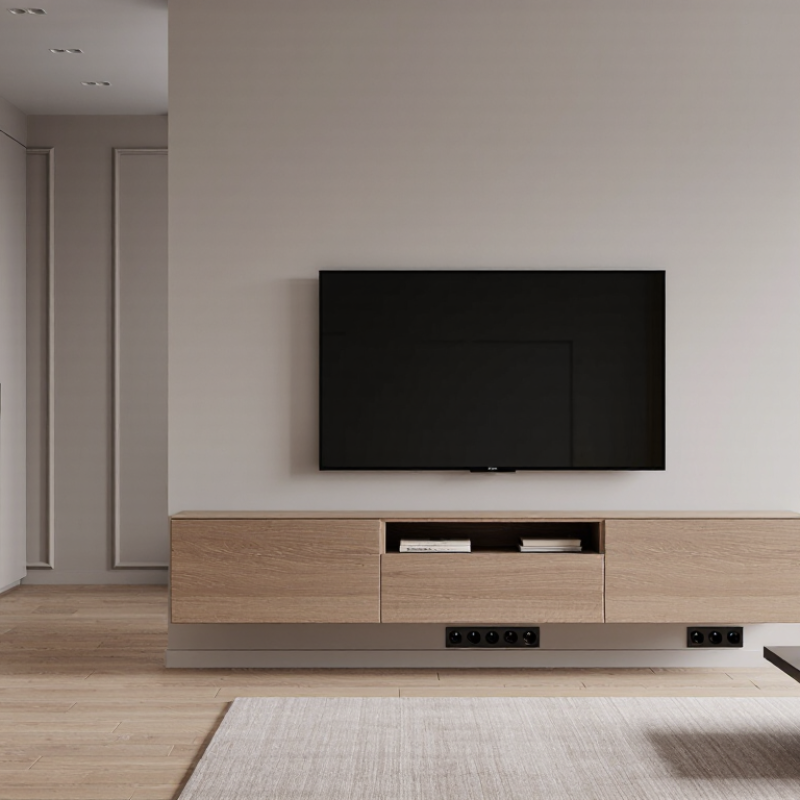
Floating TV cabinets keep the floor visible and can make compact rooms feel less crowded. They suit wall-mounted screens, but need secure fixing to a suitable wall structure. Rear cable openings help conceal power and signal leads. Check ventilation and plug access before installation. They look clean. Built-in cabinets sit flush in a recess or span a feature wall. Shelves, cupboards, and display niches can share the same layout. Modular units use separate pieces that can be rearranged as storage needs change. Corner cabinets use awkward spaces, though they may offer less room for larger equipment.

Choose materials for room conditions and daily use. Textured laminate is easy to wipe, while wood veneer shows natural grain and needs gentler care. Check shelf depth for consoles, routers, and sound equipment, not just the television. Enclosed compartments can trap heat, so ventilation matters. Measure wall width, socket positions, and viewing height before choosing a cabinet. A polished product image can hide awkward cable routes. Real rooms are rarely so forgiving. Even a small mismatch deserves a second look.

Common Materials, Mounting Methods, and Storage Configurations

2026 Top TV Wall Cabinet Types for Global Buyers?

TV wall cabinets vary in material, mounting method, and storage layout. Engineered wood with a durable laminate finish is widely used because it offers consistent surfaces and many color options. Plywood can provide stronger screw-holding than some particleboard panels, while solid wood adds character but may respond to humidity changes. Metal and glass details suit lighter, more open designs. No material is perfect.

Floating cabinets keep the floor clear and create a clean look, but the wall must support their weight. Fitters should choose fixings suited to the wall structure, not just the cabinet. Floor-standing units are easier to reposition and can hold heavier items. Bridge configurations add shelves above or beside the screen, though they need careful measuring to avoid a crowded feel. Drawers hide remotes and cables; open shelves improve access to consoles and receivers. Check ventilation and cable openings before choosing a layout.

Tips: Measure the screen, wall, and nearby outlets. Leave airflow around electronics, and confirm the loaded cabinet’s fixing requirements. A small cable gap can matter. If possible, inspect a material sample; online finishes may look different in room lighting.

How to Choose a Cabinet for TV Size, Room Layout, and Budget

2026 Top TV Wall Cabinet Types for Global Buyers?

Choosing a TV wall cabinet starts with the screen, not the style. Measure the TV’s full width, including its frame, and leave clear space around it. A cabinet that looks balanced in a showroom may feel oversized above a narrow console. For a 55-inch TV, check the actual dimensions rather than relying on screen size alone. Allow room for cables and ventilation, especially if devices sit inside closed compartments. Heat needs somewhere to go.

Room layout shapes the right cabinet type. Floating cabinets free up floor space and make compact rooms feel lighter, but the wall must support their weight. Floor-standing units are easier to reposition and can offer deeper storage. Corner cabinets may suit awkward layouts, though their usable surface can be limited. A neat floor plan can still mislead; mark the cabinet outline on the wall with painter’s tape before ordering. It is a small step, but often skipped.

Tips: Set a budget that includes delivery, mounting hardware, and installation. Compare materials and drawer quality, not just the listed price. Check wall type, cabinet depth, and the TV’s cable route before purchase. Leave a little flexibility in your measurements—rooms are rarely as square as they appear.

2026 Top TV Wall Cabinet Types for Global Buyers? — How to Choose a Cabinet for TV Size, Room Layout, and Budget

Cabinet Type Typical TV Size Suggested Cabinet Width Best Room Layout Storage & Cable Management Common Materials Indicative Budget (USD)
Floating Wall-Mounted Cabinet 43–75 in 55–80 in (140–203 cm) Compact or modern rooms where visible floor space is desirable; requires secure wall fixing. Usually drawers or closed compartments; plan cable routes and confirm wall structure before installation. MDF, plywood, particleboard, or solid wood with painted, laminated, or veneered finishes. $150–$900
Low-Profile TV Console 43–85 in 55–90 in (140–229 cm) Flexible choice for most living rooms; sits on the floor and is easy to reposition. Mix of open shelves, drawers, and doors; open sections suit devices that need ventilation. Engineered wood, solid wood, metal, or combinations of these materials. $100–$1,200
Full-Width Wall Unit 55–85 in 80–144 in (203–366 cm) Larger living rooms with a dedicated media wall and enough clearance around doors and windows. High storage capacity, often with cabinets and display shelves; check that equipment spaces allow airflow. Engineered wood, plywood, veneer, glass, and metal hardware. $700–$5,000+
Corner TV Cabinet 32–65 in 35–60 in (89–152 cm), depending on corner design Small rooms or layouts where a flat wall is unavailable; measure both adjoining walls and viewing angles. Moderate storage, commonly with shelves or doors; cable openings may be positioned at the rear. Engineered wood, solid wood, or mixed-material construction. $120–$800
TV Cabinet with Integrated Fireplace 50–85 in 60–90 in (152–229 cm) Living rooms where a combined media and visual focal point is wanted; allow for electrical access and manufacturer-specified clearances. Usually includes media storage alongside an electric fireplace insert; keep vents unobstructed. Engineered wood, metal fireplace components, and tempered glass on some models. $400–$2,500
Modular Media Cabinet System 43–85 in 60–120 in (152–305 cm), assembled to suit the room Rooms needing adaptable storage or a configuration that can be expanded over time. Configurable combinations of cabinets, shelves, and drawers; verify that modules align and are safely secured. Engineered wood, plywood, metal, or solid wood, depending on the system. $300–$3,000

Selection note: TV sizes refer to screen diagonal, not cabinet width. As a general guide, choose a cabinet wider than the TV; confirm the actual TV width, cabinet load capacity, wall type, ventilation needs, and installation clearances before purchase. Budget ranges are indicative retail estimates in USD and vary by country, materials, size, shipping, and installation.

Safety, Installation, and Market Requirements Across Regions

For global buyers, a TV wall cabinet is not only a storage choice; it also creates installation and safety considerations. Wall-mounted units keep floors clear, while floor-standing cabinets rely less on wall strength. That difference matters in homes with hollow partitions, masonry, or older plaster. Check the cabinet’s stated load capacity, then confirm the wall and fixings can support the cabinet, television, and stored items together. Do not assume the included screws suit every surface.

Installation should begin with a site check. Locate studs or sound masonry, choose a comfortable viewing height, and leave openings for ventilation and cable access. Secure heavy cabinets, especially where children may pull drawers. Keep power connections accessible and avoid pinching cables behind the unit. Small details matter. A tidy panel can still trap heat or conceal a loose fixing. Use a qualified local installer when wall construction or wiring is uncertain.

Market requirements vary by destination. Before shipment, confirm local expectations for safety documentation, electrical access, product labeling, packaging, and mounting instructions. Climate matters too: coastal humidity can affect finishes, while dry interiors may reveal gaps as materials shift. Request clear assembly drawings, load information, and replacement hardware options. Paperwork cannot replace an on-site check. Plans can look complete until a socket sits directly behind a mounting rail, so allow room for revision.

Newsletter

Keep up on our always evolving product features and technology. Enter your e-mail and subscribe to our newsletter.